
You have no items in your shopping cart.
Single-origin Arabica Coffee


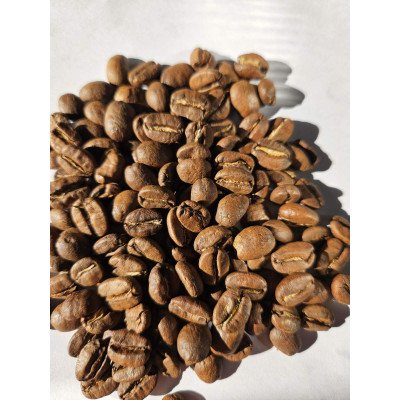
Arabica is the most popular type of coffee tree, which is used for making coffee and coffee varieties all over the world.
Arabica is one of the types of coffee trees. It grows predominantly in the tropical climates of Asia and Africa. If the Arabica is not pruned, the coffee tree can grow up to six meters in height! But, of course, when grown individually, Arabica can be cut to 2-3 meters. This is done to facilitate the collection of fruits. Arabica looks beautiful: sulfur bark, dark green glossy leaves, very fragrant white flowers. Along with flowers, Arabica also produces fruits - coffee beans. The color of Arabica fruits can be either red or purple.
Collecting Arabica has its own characteristics. Arabica fruits set throughout the year and ripen in approximately 6-8 months. That is, on one tree there can be both flowers and fruits, which makes machine harvesting of Arabica very difficult. Of course, this is only possible in Brazil, where, due to the climate, the harvest ripens almost instantly. In other countries, Arabica beans are picked by hand. Another interesting method is also used - they shake the ripe fruits of Arabica on special mats.
Immediately after harvesting, Arabica is processed. This is done to remove the grains from the shell. There are two methods of processing Arabica coffee beans on plantations - dry and wet. Depending on this, Arabica is divided into "dry", "full mita" and "semi-mita". The method of processing Arabica is chosen depending on how much water is available in a given area. The presence of special equipment for processing Arabica is also important. It so happens that Arabica is dry processed in Brazil and Ethiopia. In all other countries, Arabica is traditionally subjected to dry processing.
Arabica is very resistant to various diseases, and very sensitive to pests. If the Arabica is not preserved, the entire plantation will perish and the cultivation of coffee trees in the future will be impossible. This happened in Sri Lanka at the end of the 19th century. Many Arabica plantations there perished as a result of rusty leaves. To avoid going bankrupt, producers were forced to grow tea. Today, tea grown in Sri Lanka has established itself on its good side and is imported to many countries of the world.
Arabica is traded through the largest coffee exchange located in New York. This trade in Arabica is traditional, as Arabica prices were first set on the New York Coffee Exchange back in 1882. When trading Arabica, one pound is equivalent to one weight. And at this time, Arabica itself is stored in the largest port cities of Rotterdam, Amsterdam, Hamburg, Bremen, London, Trieste.
In general, if you compare Arabica with Robusta, another popular type of coffee, then it is quite modest ; amount of caffeine. Therefore, its effect on the body is more soft. Arabica should be chosen by those who love coffee, but want to minimize the effect of caffeine on the cardiovascular system.
